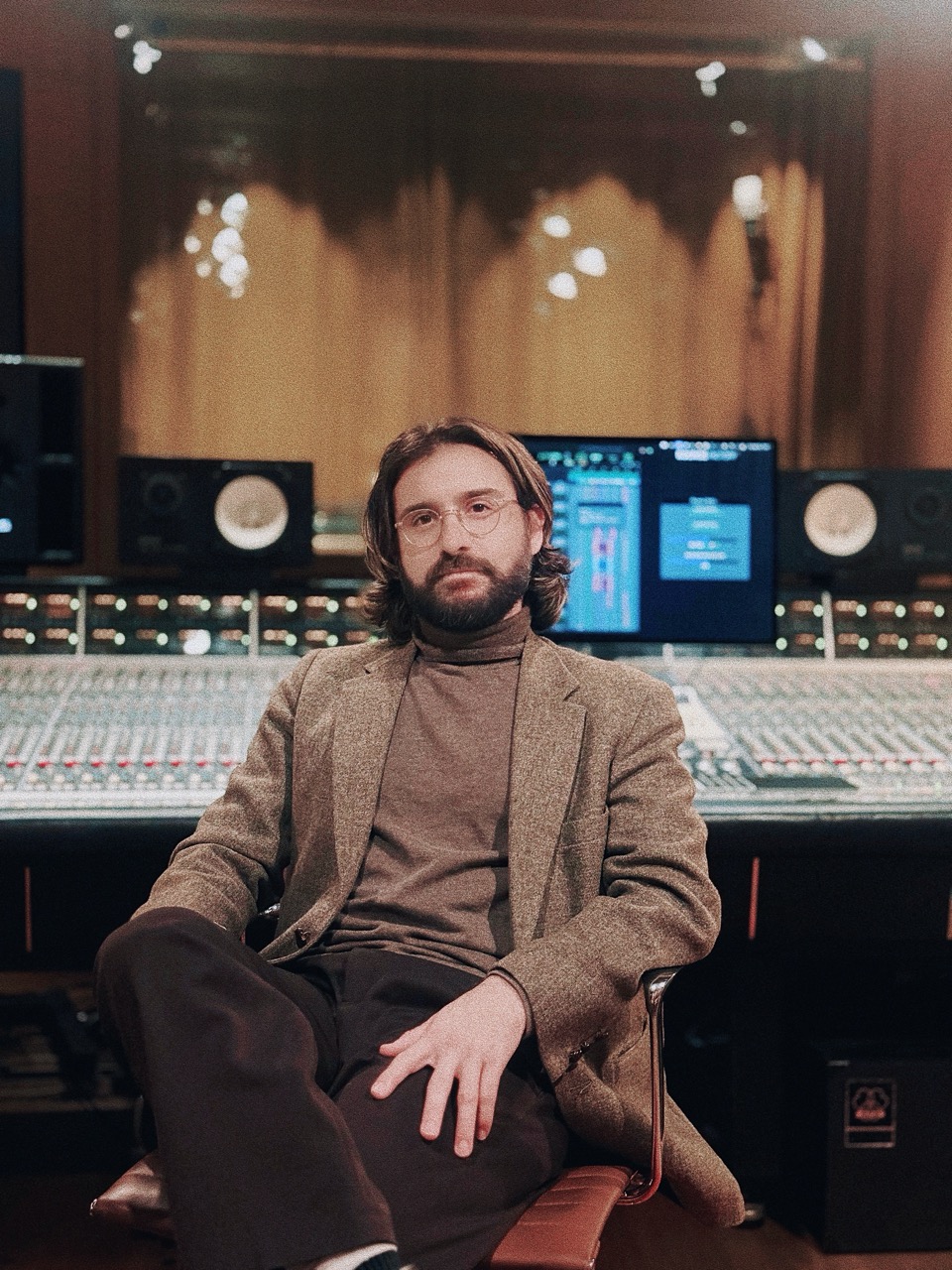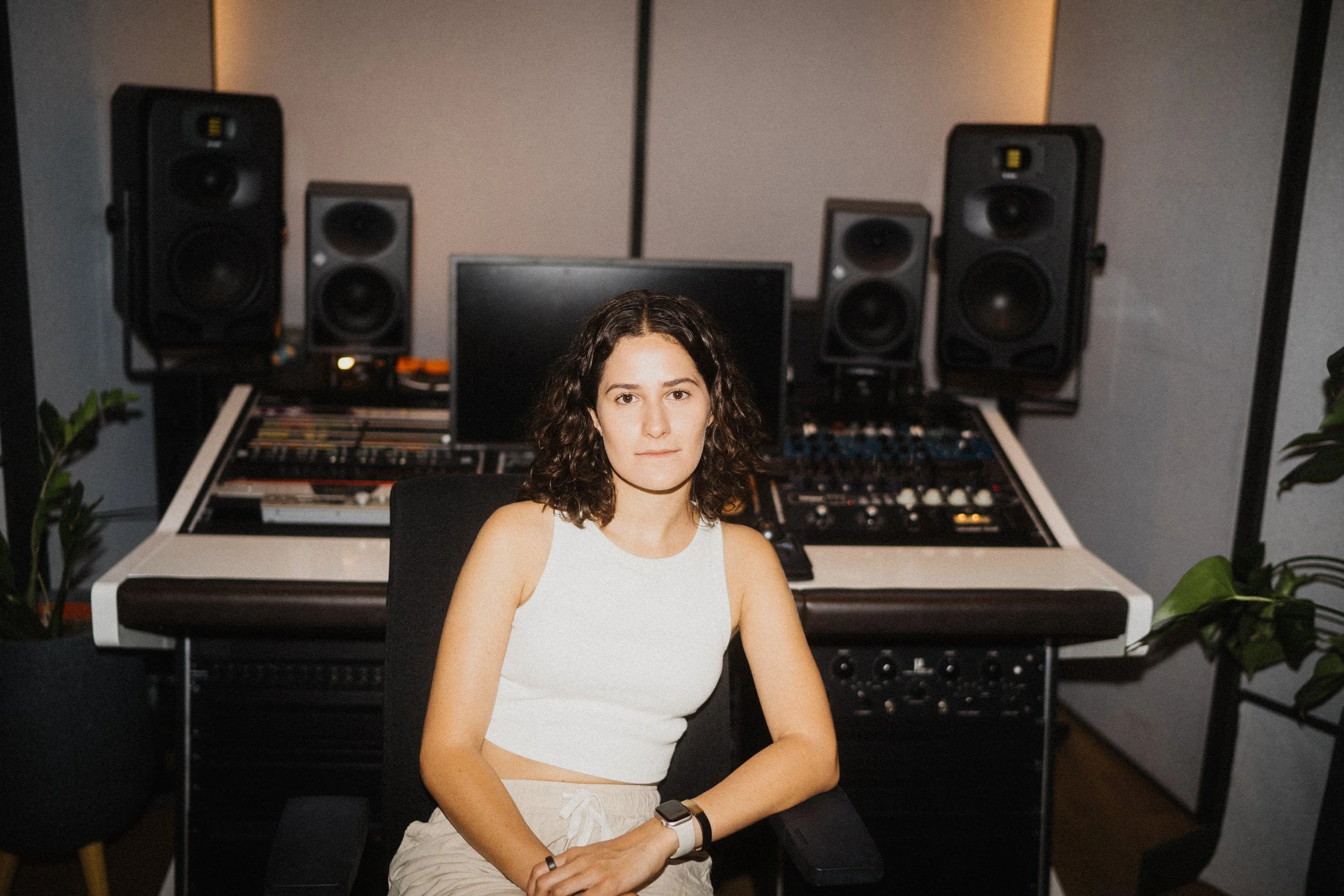
Julia Borelli is a mix engineer working across electronic and dance music, known for her precision and her ability to translate records from the studio to the club to the festival stage. She was planning to become an electronic engineer before assisting a mastering engineer in Brazil redirected her entire career. Since then, she's built a mixing business defined by long-term artist relationships, deeply intentional systems, and six burnouts that taught her more about sustainability than any success did. I was excited to sit down with her to talk about workflows, energy, pricing, trust, and what it actually takes to build a career that lasts.
Looking at your career right now, what specifically feels stable that wasn't before?
What feels much more stable now is my workflow and the systems around my work. Running a mixing business involves a lot more than just mixing. There are logistics, communication, file management, revisions, and coordination with a team. Even when I already had a team, there were still many things that required my direct involvement, which made it harder to stay focused on what actually matters - mixing!
Now I've built systems that allow those processes to run much more smoothly, so I can dedicate most of my time and energy to the creative side. That shift alone has made a huge difference in both the quality of the work and my day-to-day experience.
Another change, which is a bit harder to phrase, is how I'm perceived in the room. Earlier in my career, as a woman, I often felt like I had to prove myself as an engineer to be taken seriously. Over time, through consistency and building a strong body of work, that dynamic has shifted. Now I'm much more naturally seen and trusted as the engineer in the room, which allows me to focus fully on the work instead of on validation.
You sit between technical execution and creative direction. How did you end up in that position, and what decisions actually led you there?
I'd describe my position as someone who sits between technical execution and creative direction. I'm not just finishing records. I'm part of shaping how they translate emotionally and sonically across different contexts, whether that's streaming, clubs, or festival stages.
Interestingly, I was initially on a completely different path. I was planning to become an electronic engineer and keep music as a hobby. But I had the opportunity to assist a mastering engineer in Brazil, and very quickly I realized that this was what I wanted to do with my life.
That experience shaped a lot of how I work today. It taught me how to really listen, and it instilled a strong work ethic-many late nights, a lot of discipline, and a high standard for quality. Those lessons stayed with me. I don't stop until I feel like the sound truly serves the music and the artist is happy.
I also believe in the idea that a mix doesn't need to change a song, it needs to enhance it. That mindset, combined with consistency, clear communication, and understanding the artist's vision, is what builds trust over time.
A lot of your work comes from recurring collaborations. Artists keep coming back. What do you think you actually do that earns that?
I think it comes down to communication, sensibility, and reliability.
By sensibility, I mean the ability to understand what the artist is trying to express, even when it's not clearly articulated. A lot of the process is translating emotional or abstract ideas into technical decisions, and I think that's something artists feel comfortable relying on.
At the same time, communication is key—being clear, responsive, and easy to work with. And ultimately, they know they can count on me, both in terms of the result and the process. That combination builds trust, and trust is what leads to long-term collaborations.
Would you say your work is predictable now? And if so, what actually created that consistency?
It's predictable in terms of reliability, but not in terms of creative output. There's a consistent flow of work and happy clients, which I'm very grateful for, but each project still has its own identity.
That consistency comes from multiple layers. A lot of people think a mixing career is only about doing great mixes, but that's just one part of it. Networking, communication, branding, and structured systems and workflows are equally important. Understanding and developing those layers is what really brought stability to my career.
How has your relationship to pricing changed over time? What made you comfortable charging more?
In the beginning, pricing felt very tied to time and effort! How long something took, how complex it was, how many revisions were involved. That made it unstable, because those variables are hard to predict and control.
Over time, I realized that clients are not really paying for time, but for outcome and reliability. They're paying for the fact that the mix will work, that it will translate across systems, and that the process will be smooth and professional.
Recurring collaborations played a big role in that shift. When artists consistently come back and recommend you to others, that becomes a strong validation of your value. It removes a lot of uncertainty around pricing, because the relationship itself proves it.
Also, experience compounds. The decisions I make now are faster and more precise, but that doesn't make them less valuable. If anything, it makes them more so.
How do you think people in your scene see you now? Did you shape that intentionally, or did it just happen?
I think I'm generally seen as someone who is precise, reliable, and detail-oriented, with a strong focus on translation and clarity—from clubs to large festival systems.
That perception developed naturally through the work, but I did become more intentional about it over time. For example, the way I communicate (being clear, structured, and transparent) reinforces that positioning. At the same time, I didn't try to force a specific image. It's more about amplifying what's already true.
One thing I was more intentional about, though, was diversifying beyond being labeled only within melodic techno. Earlier, I was quite associated with that genre, and while I still love working in it, I made a conscious effort to expand into other styles. That was important for me creatively, and also for how I'm perceived in the industry.
Has your internal relationship to the work changed? Especially around confidence, pressure, and what you expect from yourself?
Yes, a lot. Earlier in my career, I struggled quite a bit with imposter syndrome, constantly questioning whether I was good enough, even when things were going well.
Over time, that shifted into a more grounded confidence. I trust my ears and my decisions much more now. But at the same time, the pressure has increased, because expectations are higher, both from clients and from myself.
So the relationship changed from doubt with low pressure to confidence with higher responsibility. I think the key difference is that now the confidence is built on experience and consistency, not just external validation.
You're clearly system-oriented. What systems actually made the biggest difference, and where do they ever get in the way?
The biggest impact came from systems that reduce cognitive load, like standardized session templates, consistent file structures, clear project tracking, and defined revision workflows.
These systems allow me to focus on creative decisions instead of administrative ones. They also make it easy to jump between projects, even ones from years ago, and immediately understand the session and context. Having all notes and structure in place is incredibly valuable.
They also improve collaboration, because assistants and my manager can easily follow the same structure.
Where systems can get in the way is when they become too rigid. Not every project fits into the same box, and creativity doesn't always follow a fixed process. So it's important to use systems as a foundation, but still stay flexible enough to adapt when needed.
You have a full life outside the studio. What have you learned about managing your energy?
The biggest realization is that energy is the limiting factor, not time. You can fill your schedule, but that doesn't mean you'll do your best work.
I've learned to pay close attention to my focus, when I'm most productive, how long I can sustain deep work, and when I need to step away. Sleep and a healthy lifestyle are essential, not optional, if I want to perform consistently, have the energy to do my best work, and still enjoy life outside of it.
Activities like tennis or simply being outside help reset my mind and bring me back with more clarity. And having Nema, my dog, naturally creates moments for breaks and movement, which is actually incredibly valuable. It prevents overworking, even on days where I'd otherwise stay in the studio the entire time.
Six burnouts by twenty-nine. What did you actually change after that?
Yes, at 29, I've had 6 burnouts in my career, mainly due to overcommitment and not having clear boundaries.
The biggest change was becoming much more intentional about capacity. I now have very open communication with my manager, so if things start to get overwhelming, we adjust before it becomes a problem.
I realized that I can't deliver good work if I'm close to burnout. And even more importantly, I don't want to lose my relationship with music. That's something I actively protect now.
Practically, that means limiting how many projects I take on, structuring my days better, delegating where possible, and maintaining a healthier lifestyle. It's an ongoing process, but it's been working! I've been burnout-free for the past two years.
Thinking back to when we worked together — what actually changed for you, and what do you think people misunderstand about that kind of work?
The biggest shift was clarity! Understanding what actually matters and what doesn't. That applied to workflows, priorities, decision-making, and also confidence.
People often expect quick fixes from that kind of work, but the real value is in perspective and the systems around it. It's about building a framework that supports better decisions over time.
So it's less about immediate results and more about long-term changes in how you operate.
What do you think your biggest strengths are? And which of those were built versus natural?
My attention to detail and musical sensitivity were more natural starting points. I've always been very focused on nuances in sound.
On the other hand, things like networking, communication, and systems thinking were developed over time. Those are skills that came from experience and necessity, and they're just as important as the technical side.
If someone's trying to get to where you are now, what are they most likely getting wrong?
A common mistake is over-focusing on tools and underestimating listening. Gear and plugins matter, but they're not what creates consistent results.
Another is underestimating the importance of relationships. Long-term collaborations are what create stability, not one-off projects. And sometimes, the connection that changes everything isn't obvious, it could be someone at the very beginning of their journey.
Also, many people overlook the importance of workflows, systems, and the business side of running a mixing career. Those are essential layers that support everything else.
Do you think there's ever a point where things are "figured out," or does it just keep evolving?
I don't think there's a point where everything is fully figured out, and that's actually what I love about this job. There's always something new to learn, new challenges, new contexts.
The goal isn't to reach a final state where everything is solved, but to build a way of working that can adapt. In that sense, being "figured out" is less about having all the answers and more about knowing how to navigate change.
If this is the part of the business that feels stuck, the Strategy Call is sixty minutes of looking at your specific situation and mapping out what to do next.
Want a self-serve diagnostic first? The Business Reality Check grades twelve systems in your business and shows you where the real bottleneck is sitting.