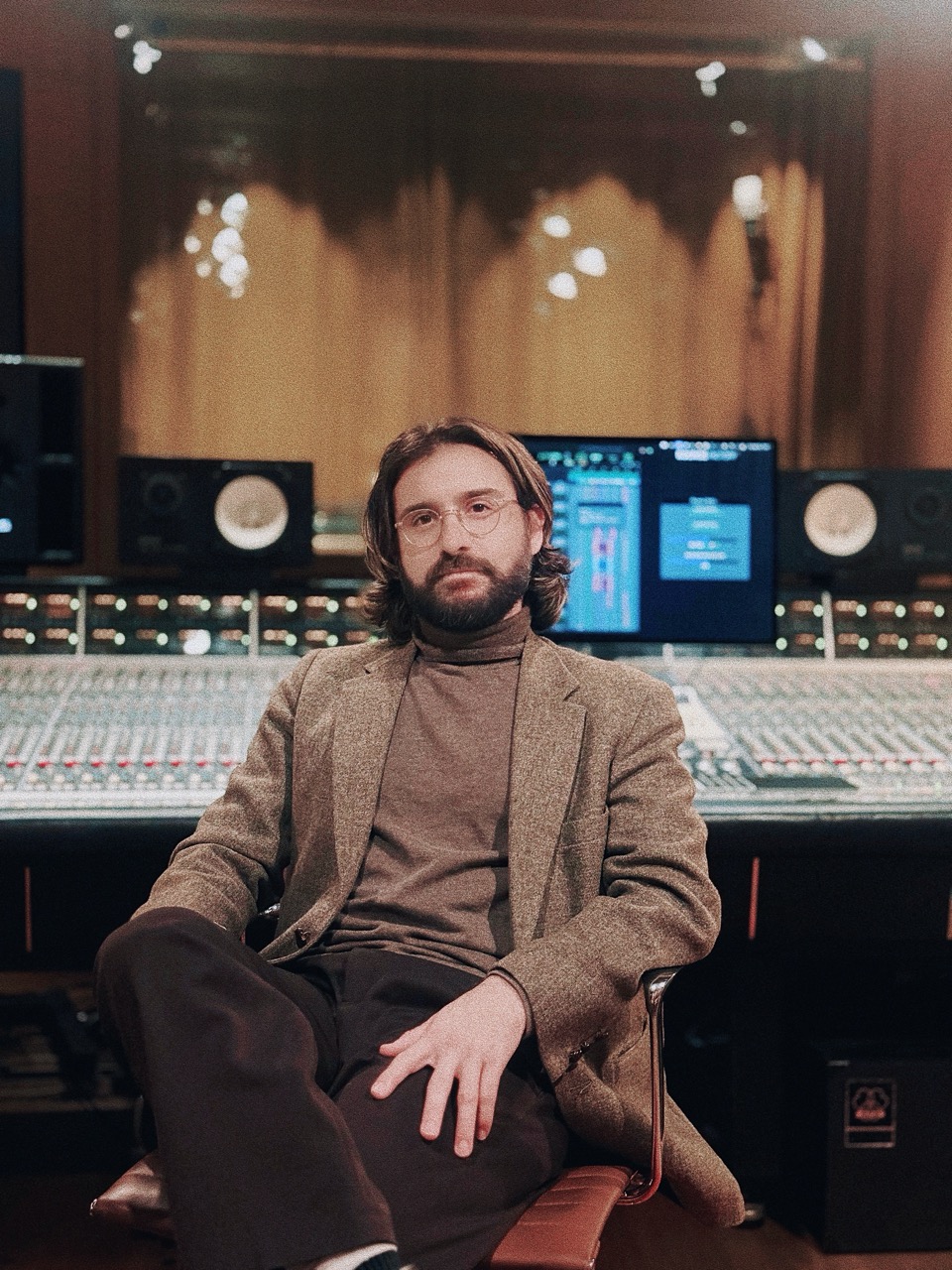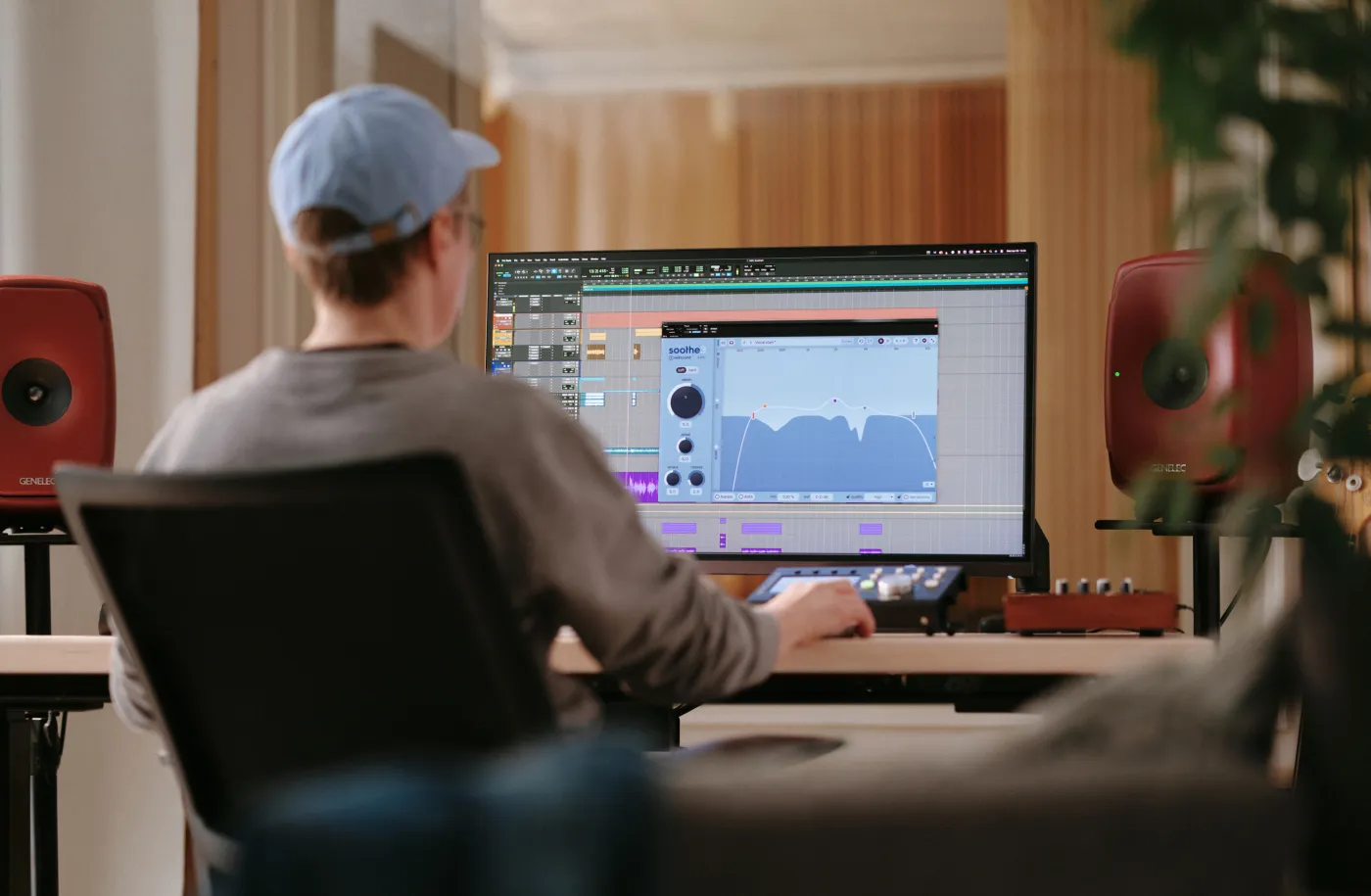
I first connected with oeksound through its CEO, Hannes Andersson, at NAMM. What stayed with me was not a specific feature pitch or product demo, but the feeling around the company itself.
In an industry that often leans on loud claims, crowded visuals, and exaggerated marketing language, the oeksound booth felt unusually calm: clean, modern, intentional, and restrained. Before we ever did the interview I had come there to do, Hannes and I ended up talking for a while about products, design, users, and the way creative tools shape behavior. That is not always what you get from the person running the company, and it told me a lot about how closely the people at the top stay tied to the craft, the customers, and the business itself.
Years later, after helping the team with early customer research for what would become Soothe3, it felt like the right moment to return to that thread. For this piece, Atte Karm answered my questions on behalf of oeksound, where he leads marketing. What came back was less a traditional plugin interview and more a conversation about automation, trust, taste, workflow, and the deeper question underneath Soothe:
Who is making the decisions in a mix?
The question underneath Soothe
Soothe3 is described by oeksound as a dynamic resonance suppressor: a tool that identifies problematic resonances on the fly and applies matching reduction automatically. The promise is simple: soothe harshness, save time. Remove harshness. Target shifting resonances. Clean up muddiness, boominess, proximity effect, sibilance, and resonant buildup without having to notch everything by hand.
That product promise is also where the philosophical tension begins. Soothe is one of those rare tools people seem to have an emotional relationship with. Some engineers swear by it. Others avoid it. Some see it as an essential workflow tool, while others see it as a shortcut.
Atte sees the reaction to Soothe as a reaction to automation, and to the discomfort some engineers feel when software appears to be making decisions inside the mix.
“There’s a degree of automation. Soothe is automatically making some decisions for the user. And that can be scary.
Some are heavily relying and welcoming those decisions. Some are horrified by the prospect. And then, of course, there’s sort of this more silent majority who kind of see it in a similar fashion as we do, that it’s a tool.
You can guide it to make the decisions that you’re trying to make. But you’re still in charge if you know what you’re doing.
I think there’s sort of a discussion of who’s making the decisions in a mix. I think that’s what it boils down to. And I think it’s always the engineer.
If some engineer is overusing Soothe, that’s their decision.
If you push Soothe2, it’s a very recognizable sound, and it’s sort of made its way into a lot of different recordings. So you hear it a lot.
I’m obviously biased on this, but I wouldn’t blame the tool. I think it’s always at the discretion of the engineer, and oftentimes an aesthetic choice.”
The product may automate part of the process, but it does not remove authorship.
Why Soothe3 had to exist
The original Soothe was released in 2016. Since then, oeksound has treated each major version as a chance to redesign the algorithm, improve sound quality, improve performance, and keep the tool flexible without losing ease of use. Soothe2 became a staple in mixes worldwide, but success creates its own kind of design problem: if many users already feel the product is finished, meaningful improvement becomes harder to define.
For oeksound, the path forward required listening to the people who loved Soothe2, but also the people who tried it and did not end up using it.
“A lot of people couldn’t answer us about what they would need to make Soothe2 better. A lot of people were like, it’s finished, it does what it’s supposed to do.
We had to actually try and find the more critical voices, maybe people that tried Soothe2 but didn’t end up using it.
Soothe2 is a really good plugin. We enjoy it, but it’s got its strengths as well as weaknesses. We thought there were problems that it didn’t solve unless it created a new one.
That’s sort of the artifacts that you can hear. That was sort of the main reason why we tried to push the tech further and make it into Soothe3.
The main thing we built it on was the more transparent algorithm, but I think a lot of the development was also about getting the UX right.”
Soothe3 is not just a better algorithm. It is a reconsideration of how quickly and confidently an engineer can solve the problem without creating new ones.
The myth of more control
One of oeksound’s most important research insights was that professional users do not automatically want more visible control. Audio software often assumes advanced users want more parameters, more options, and more granular access to everything under the hood. The feedback around Soothe3 suggested something more nuanced: depth still matters, but only when it serves the decision.
This shows up clearly in Soothe3. Soft mode is positioned as a transparent starting point for most sources. Hard mode is more reactive and can be used for a compressor-like grab, or pushed creatively in a way closer to Soothe2. The deeper controls are still available through tilt, timing, linear phase, and multichannel support up to 9.1.6, but they are packaged more cleanly.
The collapsible side panel is not just a visual choice. It is a product philosophy: keep deeper control available, but do not make every user look at every option all the time.
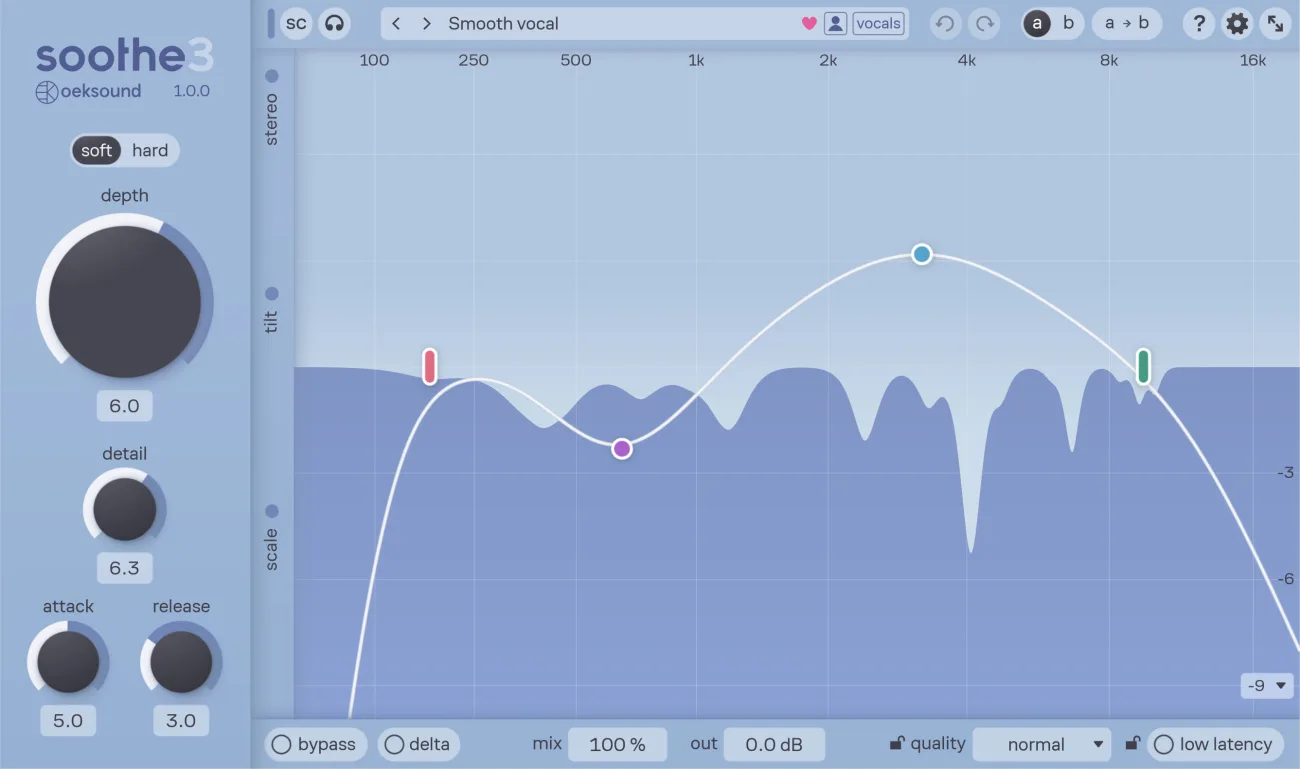
“One of the bigger revelations was that the more pro you are, like if you’re mixing full-time, just mixing, it doesn’t mean that you want more control inside the plugin.
You want to be in and out as fast as you can.
A lot of the people that are more busy with just mixing work, we found that they were looking for tools that they know what they’re doing. They have simple tools that solve the thing that they’re trying to solve. Instead of just having all these different options and granular control.
It was more about how to make the big decisions fast. That’s sort of how we got the idea for the collapsible side panel.
If you don’t need to touch all the controls, you might not want to even see them. But when you do need them, you know that they’re there.
Sometimes you might need to slow down the attack on the low end of Soothe, but that’s not a use case that you use every time.
A lot of it boiled down to having more thought-out controls that are designed around what you want to do with this plugin, and how can you get to that goal as fast as you can?”
The deeper product question is not “How many controls can we expose?” It is “What is the user trying to do, and how quickly can they get there without losing the thread?”
Intelligent tools still require intention
The product language around Soothe3 is intentionally practical. It is meant to save time, reduce harshness, clean up resonances, and help engineers reach a smoother, more balanced sound faster. With low latency mode, it can even be used while tracking, helping performers hear a more polished sound from the start.
But a tool that saves time can also create a new kind of false confidence. If an engineer does not know what problem they are trying to solve, adding a more adaptive tool may not help.
“First and foremost, you need to know your tools.
If you don’t know your tools, and you’re like, I have this issue, I’ll just slap this plugin on and see what it does, that’s most likely not gonna help you fix the problem.
The intelligent tools make it easy to just slap them on and crank them, and it might sound sort of pleasing, and you’re like, maybe this is better.
If you don’t have fresh ears, no plugin is gonna save you. You need to take a break. If you don’t know your monitoring well enough, you won’t know where you’re going.
Most engineers are so used to EQs and compressors, that they know how much they can push it before it gets dangerous, whereas with these sort of adaptive tools, it’s different with each plug-in.
They all respond differently in a sort of visual manner, and you might not be as familiar with what to listen for before they’ve gone too far and sort of ruined the mix.
You need to use them as mindfully, or even more so, than any other plugin.
Any plugin can go too far if you are not intentional about what you’re doing.”
The tool can help you move faster, but it cannot decide where you are trying to go.
Transparency as a listening test
Atte’s definition of transparency is practical. It is not framed as an abstract technical quality. It is framed as a listening test: did the tool solve the issue, and did it leave the rest of the signal alone?
That aligns with how oeksound describes the technical goal of Soothe3: reduction that only kicks in when and where needed, without affecting nearby frequency areas, preserving the timbre of the source with minimal artifacts.
“When I’m listening to the end result or the output signal, do I hear that it has been processed?
If I have a problem, and I put Soothe on and solve that problem, and then I A-B: does it do something else, something other than fixing the problem?
First and foremost, does it fix the problem? But after that, does it do something else?
If it’s not doing anything else than fixing the problem, for example creating some sort of audible artifacts, then I think it might sound transparent.”
The goal was not only stronger processing. The goal was a more trustworthy intervention.
Good taste in plugin design
For Atte, good taste in plugin design comes back to intention. Minimalism alone is not good taste. Complexity alone is not bad taste. The real question is whether the parts of the product make sense together.
Soothe3’s product design reflects that balance: soft and hard modes for different behaviors, a detail control for precision, tilt controls for frequency-specific adjustments, low latency for tracking, multichannel support for modern formats, and deeper options without making the interface feel overloaded.
“If you easily understand what a plugin is supposed to do and how you can do it, that sort of might give me an idea that it’s made in good taste.
It sort of boils down to intention. Does it feel intentional? Does it make sense that these are the parameters you can adjust? Is it conducive for the workflow that you might have?
How do the knobs feel? How heavy are they? And sort of it goes down to detail. What’s the layout? Does it make sense? And is it aesthetic?
The sort of overarching umbrella is about how does the plugin work as a whole with design, UX, how do the knobs feel, how does it look, the visual design, and how understandable it is.
It’s all about do all these building blocks make it into something that’s useful?”
Good taste, in this view, is not decoration. It is usefulness made coherent.
Trust beyond the software
That same standard appears in the way oeksound communicates. Atte describes a simple internal filter for public language: do they believe what they are saying?
This kind of restraint is part of the trust-building. The claim is still confident, but it does not ask the user to accept hype. It asks them to listen.
“For me, when we’re doing some communication, I’m thinking so much about, ‘Do I believe this?’
If we told people that Soothe3 was this revolutionary upgrade to the game-changing plugin that was Soothe2, all these superlatives would translate the whole sentence to just noise.
Saying something that people can believe, like that we think this is the most transparent Soothe we’ve ever made, that feels like something you can trust. It almost invites you to try it and see if you agree.
We’re sort of trying to have integrity about that, so that everything we say can be believed and not just marketing hype.
Almost like journalistic rules for what we can claim about our own products in a way that doesn’t water down the facts.
So many of us here in the company are plugin users. And we have such an attention to detail and try to make every aspect of our work as good as it can be.
If you try to get feedback internally, and someone’s like, yeah, I don’t know, this bit here feels a bit weird, for us it’s not like, yeah, deal with it. It’s more like, okay, let’s figure that out.”
That is the company-level version of the same product philosophy: listen closely, notice what feels off, and refine until the experience feels more trustworthy.
What mixers can learn from oeksound
The business lesson in this conversation is not about sounding corporate. It is about service design, predictability, and making the experience of hiring you feel easier to understand.
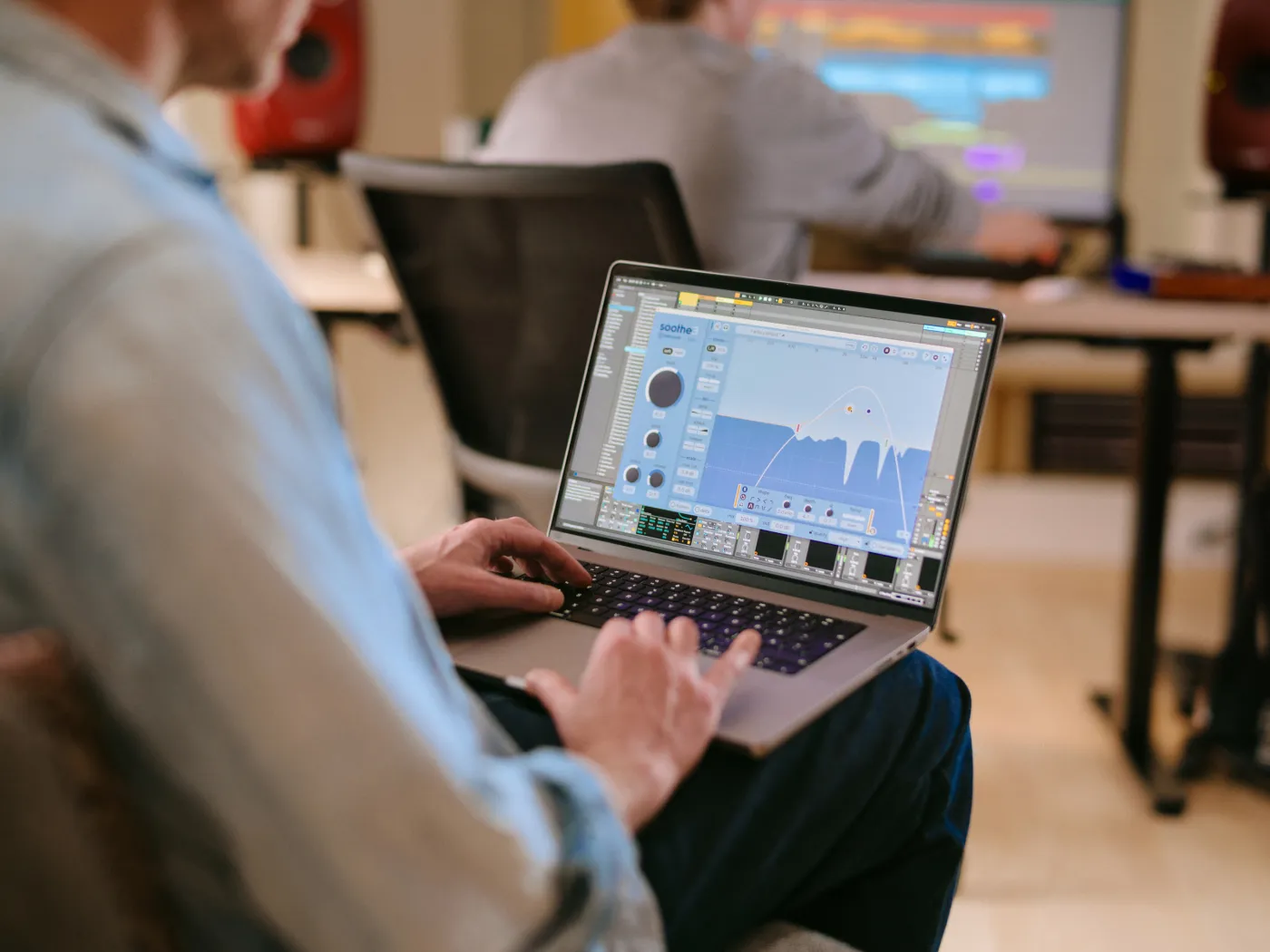
Most engineers understand the importance of sonic quality. They care deeply about the mix itself. But many do not give the same level of attention to the business surrounding the work: how projects begin, how files are received, how expectations are set, how revisions are handled, how communication happens, and how the client knows what to do next.
“People have higher expectations of systems and that kind of things than before.
If you’re using a service, you don’t want to send them files on an email. But if you’re working on a project with a mixer, that’s very common.
But if they have a website for uploading the files, that makes it easier.
If you introduce it as a sort of freelance service provider, I think we’re still at a point that it’s just gonna be a clear competitive edge for you.
If your service feels like a business, it can be much more predictable for me how this is gonna work.
I think it’s just gonna make you a lot more desirable partner in making music.
Making the conscious decision on how you serve your clients, I think makes so much sense. As opposed to just leaving it to luck.”
The point is not to become corporate or sterile. It is to consciously decide how the experience works instead of leaving it to accident.
What should stay human
Atte’s view of automation is more restrained than a lot of current conversations around audio and AI. His first thought is editing, but even there, he makes room for nuance.
When talking strictly about mixing, he is much more cautious. The clearest automation targets sit outside the creative center of the mix: session prep, bouncing, and file management.
“My first thought goes to editing, but there’s a lot of editing that can have a significant emotional impact on the end result.
When talking strictly about mixing, I think there’s nothing in the mix itself that I would want automated.
Maybe some automatic clip gaining might be interesting.
But yeah, just session prep, bouncing, and file management are sort of the clear winners in this category for me.
The accumulation of all those small decisions over the track are what makes the song what it is.”
Tools like Soothe3 can save time by reducing technical friction, but they are not presented as replacements for taste. They make certain problems faster to solve so the engineer can stay closer to the decisions that matter.
The real lesson
The most interesting thing about Soothe3 may not be the algorithm. It may be the philosophy behind the algorithm.
Atte’s answers keep circling back to the same idea: the tool can help, but the engineer is still responsible.
“You’re still in charge if you know what you’re doing.
It’s always the engineer.
Any plugin can go too far if you are not intentional about what you’re doing.”
Whether you are designing a plugin or building a mixing career, the principle is the same: the work gets stronger when the systems around it are intentional.
The engineer is still making the decisions.
That is exactly how it should be.